-->
The introduction and acceptance of Buddhism into China was a long and complex process. It is difficult to piece together history by the remnants left behind. All the people who lived in those periods are dead. They can’t talk to us today about what their life was like. The artefacts they left behind are a valuable source of knowledge because they carry the voices of these people. This essay intends to investigate firstly to what extent social and religious information can be gleaned from four Chinese artefacts. Secondly it will examine why a diversity of effigies of the Buddha and Guanyin developed over time and distance.
China was in political turmoil from approx 200-600 C.E. consequently many local kings embraced Buddhism hoping it would increase their power. Many of them preferred it because it was a new, foreign religion. The kings built monasteries and paid scholars to translate Buddhist texts from Sanskrit to Chinese. By 400C.E. the amount of Buddhist texts in China had vastly increased (Hansen 153-170).
-->
.png)
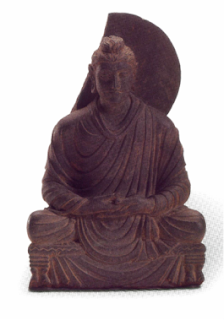
Gandharan Buddha in meditation (78 – 200 C.E.) is a small Buddha figure, 39.4cm high, carved from schist (metamorphic rock). The sculpture looks like a monk sitting in meditation pose with a halo behind him (Pang 98). The sculpture could have been used for Buddhist practise by the foreign traders that lived in the capital of China, Luoyang, in the 1st century C.E. They were some of the first Buddhists in China. Alternately they could have intended to sell it to wealthy Chinese Buddhists living in the capital. During the 2nd and 3rd centuries C.E. many Chinese began to pray to Buddha as well as the Daoist deity Laozi (Hansen 155).
Buddhism had been entwined with trade from its commencement. In India Buddha (ca. 500 B.C.E) relied on donations from Merchants to help Buddhism thrive. Monasteries and Buddhist missionaries received funds from rich businessmen who expected protection and merit in return. China’s superior quality of silk led to a lot of trade with India via the silk route. India offered semi-precious gems and glass in return. Trade from the silk road supported Buddhist clergy therefore lay people were encouraged to give silk, gems, glass and semi precious stones to the Buddha. (Hansen 155-175).

-->
Seven treasures was the traditional term for the accessories of a ruler in India. By the third century C.E. this idea had evolved to include semi precious stones and metals (Hansen 173). Tibeto-Chinese Avalokitesvara (17th – 18th century) is a 115cm high gold coloured statue set with multi coloured stones and is described to have held Buddhist symbols, now missing. (Pang 102). These characteristics are reminiscent of the seven treasures myth that developed in China (Hansen 173). This statue looks like a young man sprouting many heads and arms. It illustrates a story from Indian tantric Buddhist scripture that was translated in China during the Tang dynasty (Chun-fang Yu 155). The myth explains claims that the bodhisattva Avalokitesvara grew many heads and hands in an empathetic reaction to people’s misery (Pang 102).
Bodhisattvas accompanied living beings to enlightenment and were seen as helpers of the Buddha. They were spiritual beings who could change form as necessary to help living beings. (Paul 247). Avalokitesvara was depicted as a prince in India (Chun-fang Yu 150).
.png)
-->
Chinese Guanyin (1115 – 1234 C.E.) is a sculpture made from wood that represents Avalokitesvara dressed in a prince’s costume. The sculpture would have been decorated in gold and bright colours. His face has Chinese features (Pang 97). The name Guanyin comes from the Chinese translation of Avalokitesvara, Kuan-Yin, which means looking at the sounds [of living beings]. Avalokitesvara was famous for being compassionate to all who needed his help. Many people prayed to him in the face of sickness, natural disaster or crime. (Paul 249). Pang indicates this sculpture was used in a Chinese Buddhist temple as a means of bringing followers closer to the sacred (97).
Sculptures and paintings were an important way of communicating the meaning of Buddhist texts to people who couldn’t read. Lay people were also encouraged to print multiple images and texts of the Buddha or Guanyin in order to have their prayers answered by these deities. In turn this media helped to shape and reinforce new myths. Quite often people would claim to have seen a vision of the bodhisattva Guanyin and the vision they described would be similar to images being produced at that time. Wealthy men or kings would claim to have seen Guanyin in a dream or vision. They would then fund a temple to be built. Lay people would tell tales of miracles that happened at the site. The influence of Guanyin would grow. The temple would become a pilgrimage centre and attract even more pilgrims (Chun-fang Yu 171).
The bodhisattva Avalokitesvara underwent many changes in myth and iconography as part of the process of becoming admitted into Chinese culture. The most striking transformation was change of gender. White-robed Guanyin was a local Chinese adaptation of the bodhisattva who grew in popularity during the Song dynasty (960-1279). She was seen as a fertility goddess and had many indigenous texts written about her power to give children or an heir to childless couples. Guanyin in white robes began to be seen on the island of Putuo, off the coast of Zhejiang from the twelfth century onwards. Tales had grown about her being sighted on the island since 1080. Putuo was perceived to be the Chinese equivalent of the scriptural version of the home of Avalokitesvara, an island south of India named Potalaka. This version of Guanyin became known as ‘Guanyin of the South Sea’. The different versions of Guanyin didn’t create any problems and instead served to reinforce each other (Chun-fang Yu 156-172).
Paintings featuring Guanyin with water and moon were increasingly made by Chan artists after the Song dynasty. The moon and water are Buddhist symbols for the intangibility of the material world. However there is no connection between Guanyin and these symbols in any Buddhist scripture. Chun-fang Yu argues that Chinese artists created this concept and made it popular through widespread copying of paintings in the 8th and 9th centuries. (156-157).
.jpg)
-->
Chinese White-robed Guanyin in a landscape (14th century) is an example of this sinicisation of Guanyin. It’s a painting of a feminine Guanyin seated in meditation pose on a rocky ledge with a pine tree in the landscape above her. The sea swirls below her. She is enveloped by the moon. There is written text praising Guanyin in the top left corner added by the monk Huiming (1316 – 1386). He was abbot (1378 – 1386) of a Chan Buddhist temple in Hangzhou, Zhejiang province. This banner could have been part of the art promoting pilgrimage related to Guanyin of the South Sea because the temple that housed it was located in the province of Zhejiang, close to the island of Putuo. The sea in the painting indicates Guanyin could be on the island of Putuo (Pang 98).
.png)
-->
Scholars still don’t know all the reasons why Guanyin changed sex in China. A lot of meaning was changed through translation of Buddhist literature from Sanskrit to Chinese (Hansen 161). Buddhism was often adapted to fit in with local deities and traditions (Chun-fang Yu 169). Chun-fang Yu indicates that popular texts were transcribed from Buddhist scriptures. These were then relayed as folk tales by Chinese people (155-175). This could have contributed to constantly changing artwork which served to advertise these myths.
In summary Buddhism has gone through a long and varied process of sinicisation as part of being accepted into China. Buddhist artefacts are able to contribute a great deal of knowledge about the social and religious practices that were part of this process. Representations of the Buddha and Guanyin varied greatly over this time due to adaption and translation of Buddhist texts. Wealthy men or kings helped with the establishment of Buddhism and also influenced the versions of Buddha and Guanyin that were represented. Buddhism adapted to China successfully.
-->
Works Cited
Books:
Chun-fang Yu. “Guanyin: The Chinese Transformation of Avalokiteshvara.” Latter days of the law: images of Chinese Buddhism 850-1850. Ed. Marsha Weidner. Honolulu: University of Hawaii Press, 1994. 150-183.
Hansen, Valerie. The Open Empire: A History of China to 1600. New York: W. W. Norton, 2000. 153-177.
Mae Anna Pang, Asian art in the international collections of the National Gallery of Victoria. Melbourne: National Gallery of Victoria, 2003.
Paul, Diana Y. Women in Buddhism: Images of the Feminine in the Mahayana Tradition, Berkeley: University of California Press, 1985.
Illustrations:
Buddha, Kushan period 2nd century BCE-3rd century CE , Gandharan, National Gallery of Victoria.
Avalokiteshvara, (17th century-18th century) Tibeto Chinese, National Gallery of Victoria.
Guanyin, Jin dynasty 1115-1234, Chinese, National Gallery of Victoria.
White robed Guanyin in a landscape, (early 14th century), Chinese, National Gallery of Victoria.


