Tuesday, October 29, 2013

I want those shoes betch!

Creeber describes the growth in popularity of 'Webisodes', an online form of serialised drama that was made easier to view due to the development of flash technology used by 'Youtube'. He contrasts this phenomenon with the increasing cinematic aspects of big budget Television shows. Creeber argues that the intimacy of earlier Television drama is dissipated in slick, digitally manipulated images of new shows such as CSI: Crime Scene Investigation (CBS 2000). Shows like The Sopranos (HBO 1999-2007)have a cinematic visual style due to increased funding from subscriptions. Creeber proposes that the webisode's raw images from webcams and close-up confessional style presentation by actors is appealing to audiences who may be tired of visual spectacle and crave intimacy.

Liam Kyle Sullivan started creating videos for Youtube in 2006 and has had quite a few of his videos become viral (millions of views in a short amount of time). He created a character named Kelly and his audience followed the videos featuring her. This led to Sullivan playing Kelly in an off Broadway play as well as touring the U.S.A in a comedy show. The crossover from the internet into live performance is one that ties into the audience's craving for intimacy with the star of these comedic webisode's, Kelly. Liam's website has a variety of content and enables viewers to connect with his shows across a range of social media, thereby encouraging fan interaction with the narratives. He also continues to upload his amateur videos regularly, ensuring audience loyalty.

Creeber, Glen, It's not TV, it's online drama: The return of the intimate screen. International Journal of Cultural Studies, 2011, 14: 591. DOI: 10.1177/1367877911402589

http://www.liamshow.com/

Monday, October 14, 2013

David Halperin the Queen is not dead. - Divine / John Waters


David Halperin noticed his students were bored/dissatisfied with gay male literature. They were more excited by the edginess of queering straight culture, specifically female centred movies/TV shows. They were drawing cartoons identifying themselves with the female characters. Gays have identified with women in Hollywood and music for a long time. Halperin suspects that there needs to be a study done on this and I agree. He proposes that queering is a way of identifying with a global sense of gayness, thereby avoiding stigma and shame put on the individual person. Its an expression of gay desire that is free to go deeper into fantasy.

The expression of queer culture in the appropriation of famous female stars was firstly mined from 20th century Hollywood film. Divine channels Elizabeth Taylor in this clip from Female Trouble. There are references to the 1966 film "Who's afraid of Virginia Woolf?

David Halperin proposes that gay culture is disappearing due to gentrification, changes in law and the rise of the internet. Gentrification of inner city enclaves that were once thriving gay communities has occurred throughout the 1980's onwards. People used to have to physically go out to meet others. The internet is now a popular way to connect socially. Gay bars and newspapers are declining in numbers. The social app Grindr is widely used by gay men to hook up. The public sphere for homosexuals has changed. Now there are more gay people living in small towns that are isolated except for the internet.

The goals of gay rights have changed to gay marriage, military service and religion. These are all elements of  heteronormativity. While they are about human rights, they are also about assimilation.  Queer culture is disappearing under a blanket of heteronormativity. Halperin argues that gay men have queered heterosexual culture as a way of making their own unique space. Diversity is valuable. Reality is bland if its all heteronormative.


     Halperin, David M., How To Be Gay, Harvard University Press, 2012.

Cara Delevingne: Come and Find Me/ Fantasy, play and desire in advertising.


Why didn’t we have the revolution that Karl Marx predicted? Because Marx didn’t predict the effects technological advances have had on society. Modern medicine means we have had unprecedented population growth. Modern communications means businesses can be run globally. Mass media and advertising have had huge effects on societies consumption patterns.
Rachel Bowlby (1993) examines the psychology behind the process of consumption. She looks at sales and marketing manuals from the 1890s and the development of advertising psychology and the development of Freudian psychology in the 20th century. She compares Freud’s approach to psychology as being similar to the gain and loss scenario of ‘making up’ a term used in sales manuals from the 1920s onwards.
Bowlby describes the four basic stages of a sale as
1. Attraction
2. Interest
3. Desire
4. Sale (Action)
She describes the point at which a customer decides to buy a product as “The point at which both control over actions and mental conflict – a tension between ideas – are eliminated. “ Bowlby states that this moment is similar to the moment of recognition that occurs during analysis because it involves intuition and is a turning point.
Bowlby argues that the psychological practices of consumption make it a sophisticated process and therefore not something to be devalued or not considered. How much psychological influence have television shows and commercials had on human beings consumption habits? What kind of a play/drama are you performing every time you enter a store? Is your decision to purchase experienced as a magical moment?


Bowlby, Rachel, (1993) Make up your mind: scenes from the psychology of shopping and selling, In, Shopping with Freud (pp.94-119). Routledge. ISBN 0-415060079

Alexander McQueen : Taste and consumption


When discussing the phenomenon of consumption, Jean Baudrillard (1998) argues that popularization of a need or product can only occur after it has been first formed at an elite level of society. It then flows down to the lower and middle classes in their unending quest for improvement of status. Baudrillard refers to this pattern as a structured social field. It is a law that governs the introduction of new distinctive commodities and needs.


This theory may not always be true. Alexander Mc Queen who is from a working class background was a fashion designer, artist and showman. His innovation with design was unique. It was only after he gained popularity with the public that Givenchy employed him. This example shows how new ideas can form and grow in approval from any level of society.


McQueen's Autumn/Winter 2007 show was inspired by Elizabeth Howe, an ancestor of his who was murdered in the Salem witch trials of 1692. His shows were like performance art, his clothes were an alchemy of imagination, skill and passion.


Baudrillard, Jean (1998), The social logic of consumption. In, The consumer society: myths and structures (pp.49-68). SAGE. ISBN 0-761956921.

Friday, October 11, 2013

The value of video

In her essay 'Indigenous media: faustian contract or global village?' Faye Ginsburg discusses the use of video as cultural mediation by Indigenous people in Australia and Canada. Ethnographic filmmaking is a practice associated with Anthropology. Some filmmakers began addressing questions of ethics and agency in the 1950s and 60s. Indigenous people in Australia and the U.S. Began making their own film and media in the 1970s. The popularity of VCR's and the launch of communication satellites in the 1980s brought Western mainstream media into remote Indigenous settlements in Central Australia and Alaska. These communities used the technology to insert some of their own cultural content into the programming. (Ginsburg 1991)


Small community media groups (Warlpiri) and larger organizations (CAAMA, Imparja) began programming Australian Indigenous content in the 1980s. Works being produced were addressing historical injustices, dreaming stories, dances, music, food hunting techniques and biographies of elders. The vision and audience is local and the culture includes contemporary life. Ginsbergh (1991 105) proposes that in this way culture is preserved and also evolving at the same time.


“They [Australian indigenous produced films] are not based on some retrieval of an idealized past, but create and assert a position for the present that attempts to accommodate the inconsistencies and contradictions of contemporary life. For Aboriginal Australians , these encompass the powerful relationships to land, myth and ritual, the fragmented history of contact with Europeans and continued threats to language, health, culture, and social life, and positive efforts in the present to deal with problems stemming from these assaults.”


Francis Jupurrula Kelly is one of the key founders of Warlpiri media and he is still producing work there today. This clip shows him directing actors for a documentary co-produced by PAW media and Rebel films. He speaks two languages on set and has his own vision of how the story will be recreated. The resulting work 'Coniston' is very powerful because many people got to tell their story of the 1928 massacre for the first time. A historical crime is told from an Australian indigenous perspective. This is part of the process of identity construction through culture.

Co-writer/director Francis Kelly interviews one of the descendants of the survivors of the Coniston massacre. Ginsburg, F. (1991). "Indigenous media: faustian contract or global village?" Cultural Anthropology 6(1), 92-112.

Tuesday, September 24, 2013

Pussy Riot and the politics of fear.

Elizabeth Groeneveld (2009) argues that the feminist magazine BUST takes a neo liberal approach to feminism in a 2006 article titled "Be a feminist or just dress like one." Six important feminists served as the inspiration for a fashion spread that, although playfully ironic, clearly stripped the historical and political meaning of these figures. Groeneveld proposes that this is an example of a neo liberal approach to feminism- Lifestyle feminism. Women can choose what aspects of feminism they want to adopt and which ideas they'd like to discard. While this falls under the movement of 'third wave feminism' it is ultimately ineffective because it doesn't encourage women to examine the role of social institutions and larger organisations in regards to inequality.
"While lifestyle feminism arguably provides a version of feminism that is friendly and accessible, it does not offer an analysis of collective injustice and cannot serve as a basis for activism beyond individual acts of consumption." (Groeneveld 2009)
I read a letter from Nadezhda Tolokonnikova printed in 'The Guardian' newspaper today and I was deeply moved by her courage and conviction. She was arrested in February 2012 with members of the feminist group "Pussy Riot'for performing a song with Lyrics asking the Virgin Mary to get rid of Putin. Her group claims they are sick of the patriarchal rule in Russia making life hard for women. They ask for true democracy and better opportunities for women. I hope that Pussy Riot eventually achieve these aims. There is still a need for feminist actions that challenge institutions and demand change. These aren't always comfortable questions but they must be encouraged. These women are true heroes,standing up to injustice and oppression. http://www.theguardian.com/music/2013/sep/23/pussy-riot-hunger-strike-nadezhda-tolokonnikova ‘Be a feminist or just dress like one’: BUST, fashion and feminism as lifestyle. Elizabeth Groeneveld, Journal of Gender Studies Vol. 18, No. 2, June 2009, 179–190

Wednesday, August 29, 2012

The Pastiche of moments.

Vincent Van Gogh, A pair of shoes, 1886. "I will briefly suggest, in this first interpretative option, that the willed and violent transformation of a drab peasant object world into the most glorious materialization of pure colour in oil paint is to be seen as a Utopian gesture: as an act of compensation which ends up producing a whole new Utopian realm of the senses, or at least of that supreme sense—sight, the visual, the eye—which it now reconstitutes for us as a semi-autonomous space in its own right—part of some new division of labour in the body of capital, some new fragmentation of the emergent sensorium which replicates the specializations and divisions of capitalist life at the same time that it seeks in precisely such fragmentation a desperate Utopian compensation for them." (Jameson, p.58)
Andy Warhol, diamond Dust Shoes, 1980. Here, on the contrary, it is as though the external and coloured surface of things—debased and contaminated in advance by their assimilation to glossy advertising images—has been stripped away to reveal the deathly black-and-white substratum of the photographic negative which subtends them. Although this kind of death of the world of appearance becomes thematized in certain of Warhol’s pieces—most notably, the traffic accidents or the electric chair series—this is not, I think, a matter of content any longer but of some more fundamental mutation both in the object world itself—now become a set of texts or simulacra—and in the disposition of the subject. (Jameson,p.64)
The waning of affect, however, might also have been characterized, in the narrower context of literary criticism, as the waning of the great high-modernist thematics of time and temporality, the elegiac mysyeries of duree and of memory (something to be understood fully as a category of literary criticism associated as much with high modernism as with the works themselves). We have often been told, however, that we now inhabit the synchronic rather than the diachronic, and I think it is at least empirically arguable that our daily life, our psychic experience, our cultural languages, are today dominated by categories of space rather than by categories of time, as in the preceding period of high modernism proper. (Jameson, p.64) Jameson,Frederick, Postmodernism, or The Cultural Logic of Late Capitalism, Duke University Press Books, 1990.

Wednesday, February 3, 2010

Photomontage and Hannah Hoch.


I made a Chanel themed collage last week. I was inspired by the music of Girltalk (Gregg Michael Gillis). He is a musician who makes music from mash-ups/remixes of popular songs. You can see some really good fan videos set to his songs on Youtube. The animated video by students at Concordia University is outstanding. I really like the whole concept of creating art from popular culture like Warhol and Dada. I wanted to make something that reflected my interest in contemporary media, fashion and advertising.


Hannah Höch, Cut with the Dada Kitchen Knife through the Last Weimar Beer-Belly Cultural Epoch in Germany, 1919, collage of pasted papers, 90 x 144 cm, Staatliche Museum, Berlin.

Hannah Hoch (November 1, 1889 – May 31, 1978) was a German Dada artist. The Dadaists referred to their works as photomontage rather than collage in order to reinforce the mechanical, industrial worker associations with that word. This term also served to distinguish their work from Cubist collages.


Hoch began making photomontages in 1918 - after the end of World War 1 and the beginning of the Weimar Republic (1919). She arranged images from printed media to comment on social and political issues of this time. She was dissatisfied with the actions of the new, democratic government which still seemed to be strongly influenced by the Imperial, Militaristic forces it claimed to oppose.


Her work also evolved to contain the main theme of gender relations, in particular women's role in the new Germany. Rather than serious moralizing, Hoch presented her ideas with irony and humour.


Technically her talent for layering and patterning images in a complex style reflected her skills as a patternmaker/designer in her job at Ullstein Press. She designed and illustrated textile patterns for women's magazines.


Her work was never taken seriously by the Dadaist artists at the time, most of whom were male. Women's work wasn't valued as highly as men's in those times and indeed women had only been granted the vote in 1919. But this was also a time of universal suffrage. Hoch used her work to express her own personal dissatisfactions while at the same time observing broader social themes of marriage and bourgeois life. Taken as a whole her body of work represents an important comment and observation of women's political role in Germany.

Saturday, January 2, 2010

Smiley face - trailer Video by SMILEY FACE - MySpace Video


Smiley face - trailer Video by SMILEY FACE - MySpace Video

This is the funniest movie I've seen in a long time. Anna Faris is great as the leading character. Her strength comes from the fact that she isn't playing a role in a romantic comedy. She behaves very gender neutral and seems to be very independent. Director Gregg Araki's first film The Living End was banned in the United States because it had a gay sex scene. All of his movies contain edgy counterculture themes and characters. This movie transported me back to my twenties with its comedic portrayal of the confusion and uncertainty of youth.

Are Women as Horny as Men? from Last Pictures - Video


Are Women as Horny as Men? from Last Pictures - Video

This clip is great because it plays with gender roles. The reversal technique is also used in the Madwomen clip featured on my website. Its clever because it confronts stereotypes and expectations.

Saturday, November 28, 2009

Mad Men Website

I launched my new website last night. I made it using free templates from matthewjamestaylor.com. I chose to create it as part of an assignment for Culture, Media studies. It was a really fun, interesting experience. I found some intriguing information on Madmen too while I was researching. Jump Cut has published a fantastic essay by Mark Taylor.

Friday, October 30, 2009

Peeking behind the veil of appropriation.


'Jai Ho (You are my destiny)' performed by Pussycat Dolls. Music video by A.R. Rahman.

A.R. Rahman is one of India's most successful composer/performers. He syncretizes Western classical with Hindustani and Carnatic music to invent new styles for film scores. A.R. Rahman wrote the song 'Jai Ho' for the film Slumdog Millionaire (2008). It became a huge hit and won an Academy Award in 2009 for Best original song.

"Jai Ho" is a Hindi word that means 'May you be victorious.' The song was given a new interpretation when it was given English lyrics and released by the Pussycat Dolls on February 23, 2009. This version was titled Jai Ho (You are my destiny). It occupied number one on the Australian ARIA Singles Chart from April 27 - May 10, 2009. The music video was shot at a tramway Museum in Vienna, Austria and is directed by Thomas Kloss. It is inspired by the final scene from Slumdog Millionaire.

The fan activity with this music video has been extensive and varied. From cultural dance performances....
Choreographed dance,
Fitness routines,
Alternative film with superimposed lyrics,
to VJ Remixes
and DJ Remixes.

Matt Hills argues that the 'use-value' and 'exchange value' of an object can never be fully separated from one another. Even though fans appear to find new uses for a text that appear to depart from commercial value; these new forms can always be converted back to an item of exchange value.(35)

Many fans seem to be aware of this possibility. Many of the videos above are an advertisement for the fan's services - as a DJ, VJ, Choreographer, Dancer or Fitness Instructor. Some of them even display the fan's email address. This means that fan activity cannot be classified as a binary of commercial or utopian. It is fluid and can move between the two at any time.


It's also interesting to note that Jai Ho (You are my destiny) is an appropriation of the original song by A.R. Rahman. The fan activity further emphasizes the simulacrum effect. The issue of copyright infringement regarding fan activity was discussed in Tuesdays tutorial. The abovementioned videos illustrate one of the questions that arose from this discussion "Where is the boundary of copyright infringement?"


Matt Hills, "Fan Cultures Between Consumerism and 'Resistance'," in Fan Cultures. London: Routledge, 2002, pp.27-45.

Sunday, October 25, 2009

Farmville phenomenon


Jon Swartz (USA Today online) reports on the rising popularity of game applications on social networking sites like Facebook, Myspace and Bebo. Farmville created by Zynga has 56 million monthly users. Social gaming is a fast growing market and appears to be successful because people like to be social while playing games.

Games generate profit by selling virtual goods to upgrade the players experience. They also make money by selling advertising space. Zynga's most recent game Cafeworld attracted 10 million users in a week.

Virginia Nightingale argues that the internet is becoming increasingly popular as a place to socialise and form identity (303). People used to get together in their homes or a public place to play games. Now an individual can play a game for 5-10 minutes anytime, anywhere. I find it reassuring that even with the rise of networked individualism people still like to be social.

Reference: New Media Worlds. Ed. Virginia Nightingale and Tim Dwyer. Melbourne: Oxford University Press, 2007.

Saturday, October 24, 2009

Buddhist Artefacts in Chinese history


-->
The introduction and acceptance of Buddhism into China was a long and complex process. It is difficult to piece together history by the remnants left behind. All the people who lived in those periods are dead. They can’t talk to us today about what their life was like. The artefacts they left behind are a valuable source of knowledge because they carry the voices of these people. This essay intends to investigate firstly to what extent social and religious information can be gleaned from four Chinese artefacts. Secondly it will examine why a diversity of effigies of the Buddha and Guanyin developed over time and distance.
China was in political turmoil from approx 200-600 C.E. consequently many local kings embraced Buddhism hoping it would increase their power. Many of them preferred it because it was a new, foreign religion. The kings built monasteries and paid scholars to translate Buddhist texts from Sanskrit to Chinese. By 400C.E. the amount of Buddhist texts in China had vastly increased (Hansen 153-170).
-->
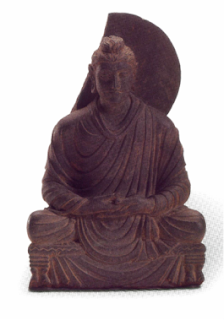
Gandharan Buddha in meditation (78 – 200 C.E.) is a small Buddha figure, 39.4cm high, carved from schist (metamorphic rock). The sculpture looks like a monk sitting in meditation pose with a halo behind him (Pang 98). The sculpture could have been used for Buddhist practise by the foreign traders that lived in the capital of China, Luoyang, in the 1st century C.E. They were some of the first Buddhists in China. Alternately they could have intended to sell it to wealthy Chinese Buddhists living in the capital. During the 2nd and 3rd centuries C.E. many Chinese began to pray to Buddha as well as the Daoist deity Laozi (Hansen 155).
Buddhism had been entwined with trade from its commencement. In India Buddha (ca. 500 B.C.E) relied on donations from Merchants to help Buddhism thrive. Monasteries and Buddhist missionaries received funds from rich businessmen who expected protection and merit in return. China’s superior quality of silk led to a lot of trade with India via the silk route. India offered semi-precious gems and glass in return. Trade from the silk road supported Buddhist clergy therefore lay people were encouraged to give silk, gems, glass and semi precious stones to the Buddha. (Hansen 155-175).

-->
Seven treasures was the traditional term for the accessories of a ruler in India. By the third century C.E. this idea had evolved to include semi precious stones and metals (Hansen 173). Tibeto-Chinese Avalokitesvara (17th – 18th century) is a 115cm high gold coloured statue set with multi coloured stones and is described to have held Buddhist symbols, now missing. (Pang 102). These characteristics are reminiscent of the seven treasures myth that developed in China (Hansen 173). This statue looks like a young man sprouting many heads and arms. It illustrates a story from Indian tantric Buddhist scripture that was translated in China during the Tang dynasty (Chun-fang Yu 155). The myth explains claims that the bodhisattva Avalokitesvara grew many heads and hands in an empathetic reaction to people’s misery (Pang 102).
Bodhisattvas accompanied living beings to enlightenment and were seen as helpers of the Buddha. They were spiritual beings who could change form as necessary to help living beings. (Paul 247). Avalokitesvara was depicted as a prince in India (Chun-fang Yu 150).

-->
Chinese Guanyin (1115 – 1234 C.E.) is a sculpture made from wood that represents Avalokitesvara dressed in a prince’s costume. The sculpture would have been decorated in gold and bright colours. His face has Chinese features (Pang 97). The name Guanyin comes from the Chinese translation of Avalokitesvara, Kuan-Yin, which means looking at the sounds [of living beings]. Avalokitesvara was famous for being compassionate to all who needed his help. Many people prayed to him in the face of sickness, natural disaster or crime. (Paul 249). Pang indicates this sculpture was used in a Chinese Buddhist temple as a means of bringing followers closer to the sacred (97).
Sculptures and paintings were an important way of communicating the meaning of Buddhist texts to people who couldn’t read. Lay people were also encouraged to print multiple images and texts of the Buddha or Guanyin in order to have their prayers answered by these deities. In turn this media helped to shape and reinforce new myths. Quite often people would claim to have seen a vision of the bodhisattva Guanyin and the vision they described would be similar to images being produced at that time. Wealthy men or kings would claim to have seen Guanyin in a dream or vision. They would then fund a temple to be built. Lay people would tell tales of miracles that happened at the site. The influence of Guanyin would grow. The temple would become a pilgrimage centre and attract even more pilgrims (Chun-fang Yu 171).
The bodhisattva Avalokitesvara underwent many changes in myth and iconography as part of the process of becoming admitted into Chinese culture. The most striking transformation was change of gender. White-robed Guanyin was a local Chinese adaptation of the bodhisattva who grew in popularity during the Song dynasty (960-1279). She was seen as a fertility goddess and had many indigenous texts written about her power to give children or an heir to childless couples. Guanyin in white robes began to be seen on the island of Putuo, off the coast of Zhejiang from the twelfth century onwards. Tales had grown about her being sighted on the island since 1080. Putuo was perceived to be the Chinese equivalent of the scriptural version of the home of Avalokitesvara, an island south of India named Potalaka. This version of Guanyin became known as ‘Guanyin of the South Sea’. The different versions of Guanyin didn’t create any problems and instead served to reinforce each other (Chun-fang Yu 156-172).
Paintings featuring Guanyin with water and moon were increasingly made by Chan artists after the Song dynasty. The moon and water are Buddhist symbols for the intangibility of the material world. However there is no connection between Guanyin and these symbols in any Buddhist scripture. Chun-fang Yu argues that Chinese artists created this concept and made it popular through widespread copying of paintings in the 8th and 9th centuries. (156-157).

-->
Chinese White-robed Guanyin in a landscape (14th century) is an example of this sinicisation of Guanyin. It’s a painting of a feminine Guanyin seated in meditation pose on a rocky ledge with a pine tree in the landscape above her. The sea swirls below her. She is enveloped by the moon. There is written text praising Guanyin in the top left corner added by the monk Huiming (1316 – 1386). He was abbot (1378 – 1386) of a Chan Buddhist temple in Hangzhou, Zhejiang province. This banner could have been part of the art promoting pilgrimage related to Guanyin of the South Sea because the temple that housed it was located in the province of Zhejiang, close to the island of Putuo. The sea in the painting indicates Guanyin could be on the island of Putuo (Pang 98).

-->
Scholars still don’t know all the reasons why Guanyin changed sex in China. A lot of meaning was changed through translation of Buddhist literature from Sanskrit to Chinese (Hansen 161). Buddhism was often adapted to fit in with local deities and traditions (Chun-fang Yu 169). Chun-fang Yu indicates that popular texts were transcribed from Buddhist scriptures. These were then relayed as folk tales by Chinese people (155-175). This could have contributed to constantly changing artwork which served to advertise these myths.
In summary Buddhism has gone through a long and varied process of sinicisation as part of being accepted into China. Buddhist artefacts are able to contribute a great deal of knowledge about the social and religious practices that were part of this process. Representations of the Buddha and Guanyin varied greatly over this time due to adaption and translation of Buddhist texts. Wealthy men or kings helped with the establishment of Buddhism and also influenced the versions of Buddha and Guanyin that were represented. Buddhism adapted to China successfully.
-->
Works Cited
Books:
Chun-fang Yu. “Guanyin: The Chinese Transformation of Avalokiteshvara.” Latter days of the law: images of Chinese Buddhism 850-1850. Ed. Marsha Weidner. Honolulu: University of Hawaii Press, 1994. 150-183.
Hansen, Valerie. The Open Empire: A History of China to 1600. New York: W. W. Norton, 2000. 153-177.
Mae Anna Pang, Asian art in the international collections of the National Gallery of Victoria. Melbourne: National Gallery of Victoria, 2003.
Paul, Diana Y. Women in Buddhism: Images of the Feminine in the Mahayana Tradition, Berkeley: University of California Press, 1985. 
Illustrations:
Buddha, Kushan period 2nd century BCE-3rd century CE , Gandharan, National Gallery of Victoria.
Avalokiteshvara, (17th century-18th century) Tibeto Chinese, National Gallery of Victoria.
Guanyin, Jin dynasty 1115-1234, Chinese, National Gallery of Victoria.
White robed Guanyin in a landscape, (early 14th century), Chinese, National Gallery of Victoria.